
Running a Sex Offender Check in Dimmit County
Start with the Texas Public Sex Offender Registry search. The Texas Department of Public Safety, or TxDPS, manages this statewide public system. Set the county filter to Dimmit, but do not stop there. A name search helps when a person is known, while an address or city search is better for neighborhood awareness. Carrizo Springs, Asherton, and Big Wells can each be entered as location terms. Results may appear in a list or on a map when that view is available.
The Dimmit County Sheriff's Office is the local fallback for registration questions outside a municipality. Its official page does not name a registry desk, publish appointment hours, or list a fee. Call 830-876-3508 and ask which authority handles the address at issue. Carrizo Springs residents should use the official city directory to confirm whether the Police Department or Sheriff is the designated local law enforcement authority. A profile's reporting-agency field is the strongest routing clue.
The official registry search form shown here is the correct first public channel for a Dimmit County registry lookup.
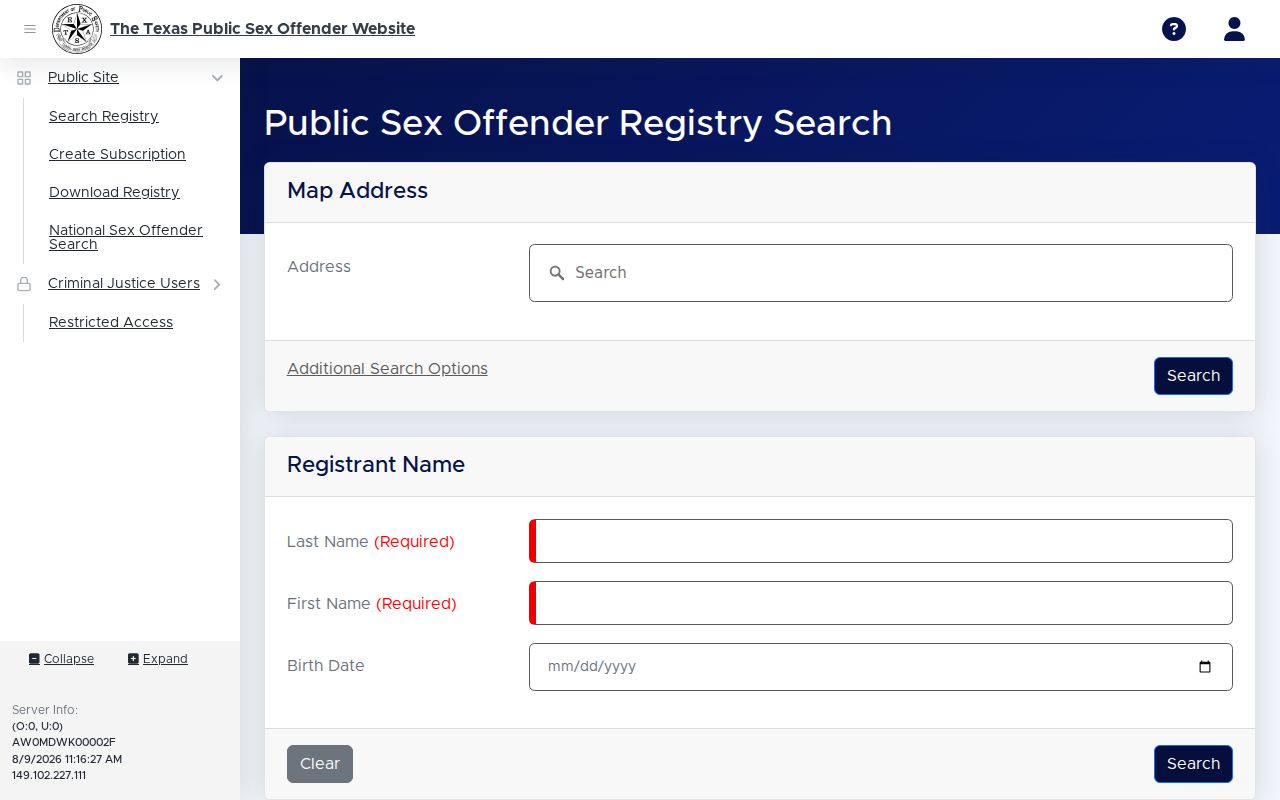
Its county and location controls make it more useful for local safety research than a broad web name search.
Set the Dimmit Registry Filter
A county-only result is a useful baseline, not a complete answer. Run separate searches for the cities or address that matter. Rural addresses may geocode poorly, and a map marker can be approximate. A name search can also find a profile whose reported address does not appear as expected. Record the date of each search because status, verification data, photographs, and addresses can change.
Use the list view to compare names, current status, and reporting agencies. Use the map to understand location, but confirm each marker by opening its full profile. Searchers near the county line or the international border should also check the national system because a Texas-only query cannot show every participating jurisdiction.
Note: An address search and a name search answer different questions, so a sound Dimmit County check uses both.
Searching the Texas Public Sex Offender Registry
The TxDPS landing flow may require acceptance of its warnings and terms. Search fields depend on the route selected. Do not assume that a blank result proves no registration exists. Spelling, aliases, location status, recent moves, and noncompliance can affect what a query returns.
- Open the official TxDPS registry and acknowledge the current conditions of use.
- Choose a name, address, or institution route, then add Dimmit County or the relevant city where the form allows it.
- Review both list and map results, and compare names, photographs, status, and reporting-agency information.
- Open the full profile and read its offense, verification, address type, and registration-term fields together.
The live interface can change, especially its radius choices. Use only the distance options shown during the search.
| Field or Control | Type | Required | Use |
|---|---|---|---|
| Search by | Tabs or routes | Route required | Name, address, or institution; advanced or map routes may appear |
| Last and First Name | Text | Surname on name route | First name narrows a surname search |
| Address and City | Text or select | Address route | Use Carrizo Springs, Asherton, or Big Wells as appropriate |
| ZIP and County | Text and select | Optional | Select Dimmit to narrow the result area |
| Radius | Select | Address route | Choose only from live distance options |
| List or Map | View control | No | Compare field detail with mapped proximity |
Dimmit Registry Alerts and Updates
The TxDPS registry information page provides the public entry point for subscription and notification functions.
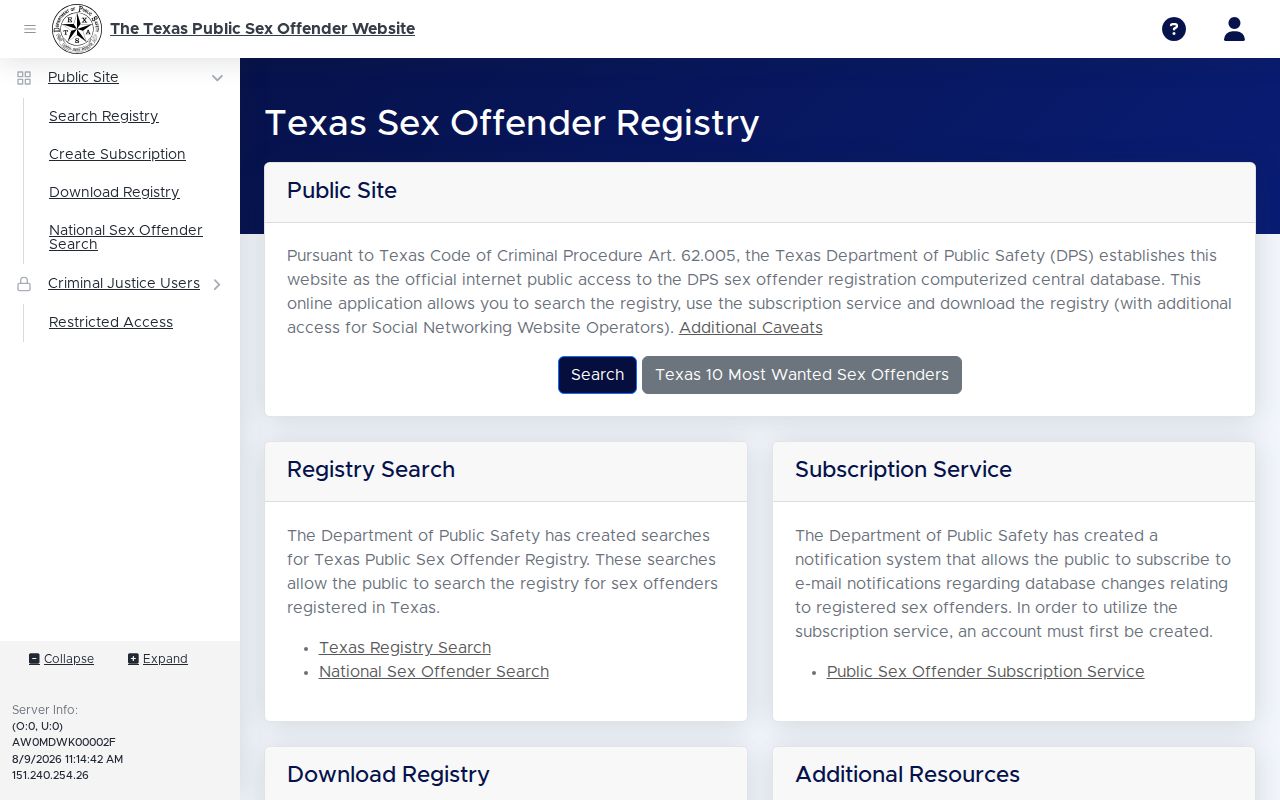
Use the live page to confirm what address changes or other events trigger an alert. Do not assume that every public profile change creates an email.
Chapter 62 community notification may involve TxDPS, a local authority, schools, or public notices, depending on the qualifying offense, risk assessment, and statutory trigger. A public listing does not mean each nearby home receives a letter. The reverse is also true. No mailed notice does not make the live registry irrelevant. For Dimmit County residents, a current search plus a supported alert subscription is more reliable than waiting for an individual notice.
What a Registry Profile Shows
A Texas registry profile combines identity, offense, location, status, and reporting information. Read the pieces together. An older photograph may not match current appearance, and an empty public field only means that no value appears there. It does not prove that the underlying fact does not exist. The verification date helps show when the registering authority last confirmed required data.
| Name and Aliases | Published names plus DPS, SID, or registry identifiers where displayed |
|---|---|
| Photo and Description | Photograph and public physical traits, which may include height, weight, hair, eyes, scars, marks, or tattoos |
| Registered Address | Primary or secondary address or location status, with the reporting authority |
| Offense Information | Offense, statute, conviction or adjudication date, jurisdiction, and victim category when lawfully shown |
| Risk Level | Low, moderate, high, or undetermined under the Texas assessment system |
| Registration Status | Verification, compliance, wanted, end-date, or lifetime indicators when supplied |
Vehicle, school, or work data may appear when public and populated. Treat each value as a registry field, not as a broader claim about the person's routine.
Dimmit Registry Searches Across State Lines
The Dru Sjodin National Sex Offender Public Website, known as NSOPW, searches public registries from participating jurisdictions.
That cross-state layer matters in a border county, but its result should lead back to the originating jurisdiction's live profile for current details.
NSOPW does not replace the Texas system. TxDPS provides the Texas profile, risk language, reporting authority, and subscription entry. NSOPW helps when a person or address connection may extend beyond Texas. Run both when the facts cross jurisdictions, then compare identifiers instead of treating a similar name as a match.
Dimmit Federal Dockets Are Not Registries
Federal court dockets are another distinct source. The PACER account and case-record service may hold federal case filings.
PACER is not a sex offender registry, address map, compliance list, or notification service. Use it only for a known federal court case, not as a substitute for TxDPS or NSOPW.
Registration Requirements and Levels in Texas
Texas uses numeric risk levels, not the federal SORNA Tier I, II, and III labels as its public risk vocabulary. Level one means low, level two moderate, and level three high; a result can also say undetermined. The risk category helps guide notification. It does not set the registration term. Duration follows the qualifying offense and the rules in Chapter 62.
The official Texas sex-offender registration statute is the controlling source for reportable offenses, verification, duration, notification, noncompliance, and specialized relief.
The statute shows why a risk label and a registration end date must be read as separate facts.
| Registration Rule | General Duration | Verification |
|---|---|---|
| Listed sexually violent and other enumerated offenses | Lifetime unless statutory relief applies | Generally annual; certain lifetime registrants verify every 90 days |
| Other reportable convictions or adjudications covered by Article 62.101(b) | Ten years after release, discharge, or supervision ends | Generally annual, subject to Chapter 62 rules |
| Juvenile or early-termination situations | Specialized statutory rules | Confirm from the order, profile, and registering authority |
Do not infer a lifetime or ten-year term from low, moderate, or high risk. Address changes and other registration data also have reporting deadlines. The listed authority can explain where a Dimmit County registrant reports, but legal questions about duration belong with the statute, the court order, or counsel.
Dimmit Registry Maps Set No Legal Radius
A radius drawn on the registry map is a search tool. It is not proof of a legal residency boundary. Chapter 62 does not create one universal Texas statewide distance restriction for every registered person. Conditions of parole or community supervision may add limits, and a municipal ordinance can differ. The actual rule must be checked with the supervising agency, local code, or controlling court order.
This distinction protects against two common errors. A person outside a chosen map circle may still be subject to a specific condition, while a person inside that circle is not automatically violating one. Map results support personal and family safety planning. They do not decide compliance.
Report Dimmit Registry Noncompliance
Suspected errors or noncompliance should go to the reporting local authority shown on the profile. If the responsible office is unclear, use the Dimmit County department directory or call the Sheriff's Office at 830-876-3508. Give the profile identifier, explain the observed issue, and let law enforcement assess it. Do not approach, follow, photograph, or investigate the listed person.
Failure to comply can be a felony under Article 62.102, with the grade tied to the required registration period, verification schedule, and prior convictions. A member of the public does not make that legal determination. A stale address, approximate map point, or old photograph can call for agency review, but none alone proves a new crime.
Note: The reporting agency can check source data that is not exposed in the public Dimmit County registry profile.
Lawful Use and Community Notification
Registry access exists for public safety and community awareness. Use it to understand an address, plan an informed family conversation, or monitor a location through official alerts. Texas requires the public to respect the same law while viewing that information. A profile is not permission for confrontation, publication of private household details, threats, or damage.
Community notices depend on Chapter 62 triggers and local duties. The live registry remains the central source when no individual notice was received. Verify a profile through TxDPS and refer a suspected issue to the named authority.
Use registry information lawfully: Chapter 62 warns that registry data may not be used to injure, harass, or commit a crime against a registrant or household. Threats, vigilantism, property damage, and unlawful discrimination are not public-safety uses.